
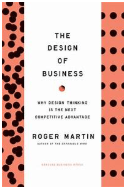
At the core of Roger Martin’s latest book, “The Design of Business: Why Design Thinking is the Next Competitive Advantage” details how “Design Thinking” is more than just a trait or skill of a designer but instead a requisite corporate capability of the 21st century.
The book thoroughly explores key capabilities of the “design-thinking” organization and how this translates to an organization’s ability to not only lead but to also sustain itself in today’s rapidly changing markets. Martin reveals the origin of the “design thinking” concept and describes the work of early pragmatic philosophers to uncover how new ideas originated in the face of an attention priority to understand the process of validating or dismissing scientific hypotheses.
These philosophers pursued the argument that one could gain understanding only through one’s own experience and that original ideas did not come from the conventional forms of declarative logic but instead came by way of logical leaps of the mind. Through their research “logical leaps of the mind” became recognized as a new form of logic named “ abductive reasoning. Unlike the existing forms of declarative logic, abductive reasoning was not based on an observation to be classified as true or false but instead was based on wondering what might possibly be true.
Most recently, the notion of abductive reasoning has been re-articulated as “design thinking” for the business world by Tim Brown of IDEO. Brown describes design thinking as discipline that uses the designer’s sensibility and methods to match people’s needs along side the corporate strategy demands that requires 1) what is technologically feasible and 2) what is a viable business strategy that can convert gaps and problems into customer value and market opportunity. “ The addition of these two requirements as imperatives to the definition design thinking in business points out the potency of leveraging design discipline management with traditional business planning as a both a strategy and as an requisite internal core competency.
Both Martin and Brown note that designers live in this world of abduction, actively looking for new data points, challenging accepted explanations, and inferring possible new worlds. They also are aware that this approach can be extremely unsettling to business minded executives who have been thoroughly trained in the declarative decision making process.
The point is that businesses today, can greatly advance their ability to create sustainable advantage by leveraging BOTH traditional business planning and measurement approaches in conjunction with the successful approaches put forth by the design management discipline. Just as traditional business planning of the past has relied on analytical reasoning offered up by scientific research approaches of providing the one right answer, Martin argues the time has come for businesses to ALSO rely on those capabilities offered up by the creative design management process that can suspend numerous possibilities simultaneously.
Resource: “The Design of Business: Why Design Thinking is the Next Competitive Advantage,” Roger Martin, Harvard Business Press, 2009.

 Modern Business Strategy, Experience, and Design