
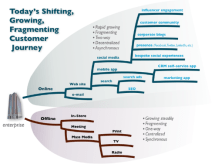
The promise of completely understanding how and when a customer chooses to interact with your brand is the ultimate holy grail of customer experience optimizations. Researching this end-to-end journey from the customer’s perspective reveals their needs and potential pain points at any given moment and across any number of customer facing touch points.
This effort reveals insights that give a company significant strategic advantage.The power of adopting a journey-centric approach provides for a shift in strategy from independent functions and top-down innovation to cross-functional processes and “empowered, bottom-up innovation.”
Understanding your customer’s end-to-end journey, as opposed to measuring single and siloed touch points is a powerful approach for simultaneously optimizing brand, revenue, and profit. This approach however is not an easy undertaking. Any company innovative and brave enough to take on the challenge of this holistic perspective faces a number of challenges.
The core challenge in taking on this approach is the fact that various functional customer-facing services are distinctly separate across the enterprise. These silos prevent a holistic view of the customers true needs or desires overall.
A Customer-Experience team lead by an executive level leader is best positioned to lead this type of initiative and succeed compared to any other functional group. This team is empowered to lead transformational programs that address “a whole new way of managing its service operations in order to reinvent the customer journeys that mattered most.”
The four ways to embed customer journeys into their operating models:
1. Identifying Key Journeys
To implement the value of well-understood customer journeys into a company’s operating model requires that companies “must identify the journeys in which they need to excel, understand how they are currently performing in each, build cross-functional processes to redesign and support those journeys, and institute cultural change and continuous improvement to sustain the initiatives at scale.”
2. Understanding Current Performance
The key lesson with respect to performance is that it is very easy to get blinded by the “traditional customer-experience dashboards.” These views do not typically include measures of end-to-end success. Things can look extremely rosy when in fact customers are actually outraged because a need is being consistently overlooked. The effort to integrate these points-of-view into a more comprehensive and clear understanding of “the customer’s experience of various journeys and decide which ones to prioritize.”
3. Redesigning the Experience and Engaging the Front Line
All the teams that deliver customer-facing services across the enterprise must come together as a cross-function team and begin to share their own perspectives of the customer’s problems. The share visibility across functional teams drives the identification of gaps and solution designs. “Some of the unhappy customers’ frustration arose from a lack of communication at key moments … or customers got too much information and were confused by apparently conflicting messages.”
4. Sustaining at Scale by Changing Mindsets
Of course, taking the discoveries of the cross-functional teams collective approach becomes the ultimate execution and change management challenge. The to move to a customer journey-centric operational model ultimately requires “a central change leadership team with an executive-level head to steer the design and the ultimate solution. However, delivering at scale on customer journeys requires two high-level changes that merit mention here: (1) modifying the organization and its processes to deliver excellent journeys, and (2) adjusting metrics and incentives to support journeys, not just touch points.”
Reference: The Truth about Customer Experience, HBR, September 2013 Issue, Alex Rawson, Ewan Duncan, Conor Jones

 Modern Business Strategy, Experience, and Design