
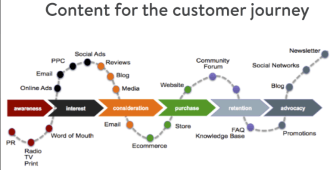
 The topic of Customer Experience has become increasingly more common and central to the conversation between consumers, business owners, and brands. The most important topic is one which both includes and resonates with the customer so that companies are fully prepared to understand and stay current will all of their customer’s point of view and daily needs.
The key starting point for any brand is to fully appreciate what a customer may need, at any given time as opposed to a single transaction that is currently at hand. In other words, what are the various customer journeys that a brands consumers must travel to not only feel satisfied but feel elated. As consumers, we know very well those journeys that drive us away from a brand. These experiences are so obvious to us but why are they elusive to the brand?
In HBR’s “The Truth about Customer Experience, September 2013″ the topic of company’s that have managed to understand key customer journey’s, address these journey’s across the company, and how this capability translates to both their profitability and competitive advantage. At the heart of these strategies logically centers on a new way of managing its service operations in order to reinvent the customer journeys that mattered most.”
The article outlines the four ways companies can approach the need and change to embed customer journeys into their operating models. Here is a summarization:
- Identifying Essential and Key Journeys
This requires “combining operational, marketing, and customer and competitive research data to understand journeys.” This involves a lot of effort, can take a while, and a broad senior level executive commitment. “But the reward is well worth it, because the fact base that’s created allows management to clearly see the customer’s experience of various journeys and decide which ones to prioritize.”
- Understanding Current Performance of these Key Journeys
The current company’s customer service metrics likely have missed any problems because they are transactionally based. Measures of end-to-end success are hard to calculate and have not been part of the traditional customer service role. “Our dashboard metrics were like a watermelon,” one senior manager told us. “On the outside everything was green, but when you looked inside, it was red, red, red.”
- Redesigning the Experience and Engaging the Front Line with New Cross-Functional Processes
“Only by getting cross-functional teams together to see problems for themselves and design solutions as a group can companies hope to make fixes that stick.” “Seeing the journey represented from start to finish was powerful, because no single group had ever had visibility into—let alone accountability for—the entire experience, and therefore didn’t recognize the journey’s shortcomings.”
- Sustaining at Scale by Changing Mindsets Requires Cultural Change
However, delivering at scale on customer journeys requires two high-level changes that merit mention here: (1) modifying the organization and its processes to deliver excellent journeys, and (2) adjusting metrics and incentives to support journeys, not just touch points.
The Challenge:
“Organizationally, adopting a journey-centric approach allows companies to move from siloed functions and top-down innovation to cross-functional processes and empowered, bottom-up innovation. Most companies keep their functional alignments intact and add cross-functional working teams and processes to drive change. To that end, many companies we have studied set up a central change leadership team with an executive-level head to steer the design.”
Reference:
The Truth about Customer Experience, HBR, September 2013 Issue, Alex Rawson, Ewan Duncan, Conor Jones

 Modern Business Strategy, Experience, and Design